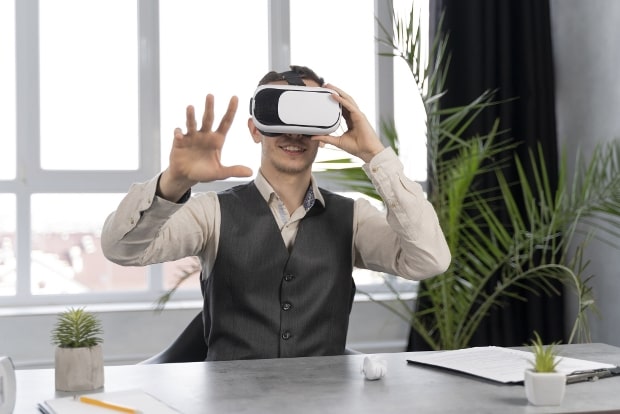
In the evolving landscape of remote work, the ability to collaborate effectively across distances has become paramount. Augmented Reality (AR) has emerged as a transformative technology, reshaping the way remote teams interact, communicate, and collaborate. This article explores the various ways in which AR is revolutionizing remote team collaboration, enhancing productivity, and fostering innovation.
The Rise of Remote Work and the Need for Enhanced Collaboration
The COVID-19 pandemic accelerated the shift to remote work, making it a permanent fixture for many organizations. While remote work offers numerous benefits, it also presents challenges in maintaining effective communication and collaboration among team members. Traditional tools like emails, video calls, and messaging apps often fall short in replicating the immersive and interactive nature of in-person meetings. This is where AR steps in, providing a bridge between physical and virtual workspaces.
What is Augmented Reality?
Augmented Reality (AR) is a technology that overlays digital information, such as images, videos, or 3D models, onto the real-world environment. Unlike Virtual Reality (VR), which creates a completely virtual environment, AR enhances the real world by adding virtual elements to it. This technology can be accessed through smartphones, tablets, AR glasses, or specialized headsets, making it versatile and accessible for various applications.
AR Tools and Platforms for Remote Collaboration
Several AR tools and platforms are designed specifically to enhance remote collaboration. These tools offer features that go beyond traditional communication methods, providing immersive and interactive experiences.
AR Meeting Platforms
AR meeting platforms like Spatial and MeetingRoom provide virtual spaces where remote teams can collaborate in a shared augmented environment. These platforms allow users to create and manipulate 3D objects, share screens, and interact with digital content in real time. The immersive nature of these platforms makes remote meetings feel more engaging and productive.
AR Project Management Tools
Project management tools integrated with AR capabilities, such as TrelloAR and BaseAR, enable teams to visualize project timelines, tasks, and workflows in a 3D space. This spatial representation helps team members understand project progress, identify bottlenecks, and collaborate more effectively.
Enhancing Communication with AR
Effective communication is the cornerstone of successful remote collaboration. AR enhances communication by providing visual and spatial context that is often missing in traditional remote communication tools.
Visualizing Complex Data
AR allows teams to visualize complex data in a more intuitive and interactive way. For instance, data analytics teams can use AR to create 3D models of data sets, making it easier to identify patterns and insights. This visual representation helps teams make more informed decisions and communicate findings more effectively.
Remote Assistance and Training
AR is particularly useful for remote assistance and training. Technicians can use AR glasses to receive real-time guidance from experts who can see what they see and provide step-by-step instructions. This capability is invaluable for industries like manufacturing, healthcare, and field service, where remote expertise can significantly reduce downtime and improve efficiency.
Boosting Creativity and Innovation
AR fosters creativity and innovation by providing new ways for teams to brainstorm, design, and prototype.
Collaborative Design
Design teams can use AR to collaborate on product designs in real time, regardless of their physical location. Tools like SketchAR and Adobe Aero allow designers to create 3D models and visualize them in a real-world context. This collaborative approach speeds up the design process and ensures that all team members are aligned.
Virtual Prototyping
AR enables teams to create virtual prototypes of products, allowing them to test and refine designs before creating physical models. This iterative process reduces costs and accelerates the time-to-market for new products.
Overcoming Geographical Barriers
One of the most significant advantages of AR in remote collaboration is its ability to overcome geographical barriers. By creating a shared virtual space, AR allows team members from different parts of the world to work together as if they were in the same room.
Global Team Building
AR can be used for virtual team-building activities, helping remote teams build stronger connections and improve morale. Virtual escape rooms, scavenger hunts, and interactive workshops are just a few examples of how AR can bring teams closer together.
Cultural Exchange
AR can facilitate cultural exchange by allowing team members to share their local environments and experiences with each other. This immersive cultural exchange fosters understanding and collaboration among diverse teams.
Challenges and Considerations
While AR offers numerous benefits for remote collaboration, there are also challenges and considerations to keep in mind.
Technical Limitations
AR technology requires robust hardware and software infrastructure. Not all team members may have access to the necessary devices or a stable internet connection, which can limit the effectiveness of AR collaboration tools.
Security and Privacy
The use of AR involves the sharing of potentially sensitive information and data. Organizations must implement strong security measures to protect this information and ensure compliance with privacy regulations.
Learning Curve
Adopting AR tools may require training and a learning curve for team members. Organizations need to invest in training programs to help employees become proficient in using these new technologies.
The Future of AR in Remote Collaboration
The future of AR in remote collaboration looks promising, with ongoing advancements in technology and increasing adoption across various industries. As AR becomes more accessible and affordable, we can expect to see more innovative applications and integrations that further enhance remote team collaboration.
Integration with Other Technologies
AR will likely be integrated with other emerging technologies like Artificial Intelligence (AI), Internet of Things (IoT), and 5G. These integrations will create more intelligent and connected collaboration environments, enabling teams to work more efficiently and effectively.
Expansion into New Industries
While AR is already being used in industries like manufacturing, healthcare, and design, its potential applications extend far beyond these fields. Education, retail, real estate, and entertainment are just a few examples of industries that can benefit from AR-enhanced remote collaboration.
Conclusion
Augmented Reality is transforming the way remote teams collaborate, offering immersive and interactive experiences that traditional tools cannot match. By enhancing communication, fostering creativity, and overcoming geographical barriers, AR is paving the way for a new era of remote work. As technology continues to evolve, the role of AR in remote collaboration will only grow, creating new opportunities for innovation and productivity.